


10% off at Lupit Pole
We train on Lupit Pole. With the code POLEPLACE10 you get 10% off in the Lupit shop.
For most beginners with a solid, flat ceiling, a ceiling pole is the easier, lighter and more affordable choice. A freestanding stage pole is the better fit when your ceiling cannot take a pressure pole, when it is sloped or suspended, or when you want to move your pole between rooms or locations. Stage poles need more floor space, more budget and still a fair amount of room height.
Short answer: If your ceiling passes the check, start with a ceiling pole such as the Lupit Classic G2. If it does not, a stage pole like the Lupit Stage or the X-Pole X-Stage Lite lets you dance without any ceiling contact. Our guide to the best pole for home puts all options side by side.
What is the difference between a stage pole and a ceiling pole?
A ceiling pole is fixed between floor and ceiling. Most home versions are pressure-mounted: an adjuster pushes the pole against the ceiling until it sits tight, with no drilling. Some setups, such as sloped or very high ceilings, use a mount screwed into the ceiling.
A stage pole stands on its own. It sits on a wide, heavy podium, sometimes with stabilising legs, and its weight and footprint keep it upright. It never touches the ceiling.
Both types are available with a switch between static and spinning mode, so the way you learn moves stays the same. If you are still deciding on the mode, read static vs spinning pole.
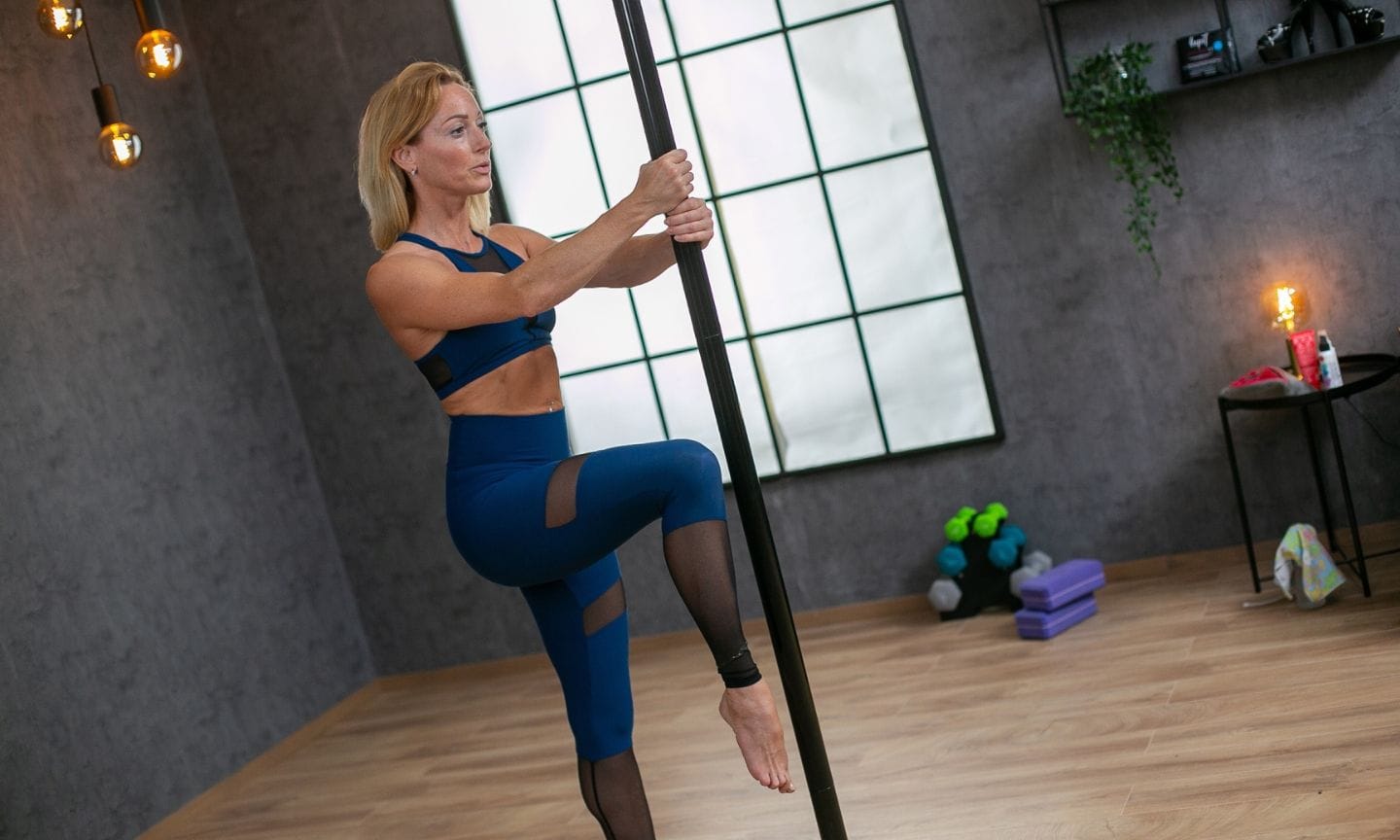
Stage pole vs ceiling pole at a glance
| Ceiling pole (e.g. Lupit Classic G2) | Stage pole (e.g. Lupit Stage, X-Pole X-Stage Lite) | |
|---|---|---|
| Needs a suitable ceiling | yes | no |
| Room height | standard set 2,300–2,800 mm (Lupit Classic G2) | full height needs more than 3 m; shorter versions available |
| Floor space for the pole itself | small base | podium about 1.6 m in diameter |
| Weight | shipping weight 15.7 kg (Lupit Classic G2) | about 80 kg net (Lupit Stage), 90 kg unboxed (X-Stage Lite) |
| Setup | quick, one person possible (Lupit) | longer, heavier parts |
| Drilling | no (pressure-mounted) | no |
| Static/spin | yes | yes |
| Price (Lupit US shop, list price) | Classic G2 from $395 | Lupit Stage $1,184.90–$1,299.90 |
When is a ceiling pole the better choice?
A ceiling pole wins in most homes, for a few simple reasons:
- It takes little space. Apart from the circle you dance in, the pole itself only needs a small base. The Lupit Classic G2 has a lower disc of 120 mm and an upper disc of 200 mm.
- It is light and quick to set up. Lupit says one person can install its home pole in a few minutes without drilling.
- It is usually cheaper. Stage poles carry a heavy podium and more parts, which is reflected in the price.
- It fits normal room heights. Standard sets of common home poles cover ceilings of around 2.3 to 2.8 m. Details in our article on ceiling height for a pole.
The condition is a ceiling that can take the pressure: Lupit puts the load at about 80 to 120 kg and prefers concrete or hard wood. Plasterboard needs a joist or reinforcement, and suspended ceilings are not suitable.
When is a stage pole the better choice?
A stage pole earns its price in situations like these:
- Your ceiling is not suitable. Suspended ceilings, weak plasterboard without a reachable joist, or a ceiling you are not allowed to touch.
- You have a sloped ceiling and cannot drill. Slope mounts for ceiling poles are screwed into the ceiling, as Lupit’s slope ceiling mount is. A stage pole avoids that.
- You want to move the pole. Between rooms, to a workshop, a garden party or a performance. X-Pole describes the X-Stage Lite as totally portable, with carry cases included.
- You teach or perform. For workshops or shows, a pole that does not depend on the venue’s ceiling is a big plus.
In a rental, a stage pole can also be the calmer option because it leaves the ceiling alone. Read more in our guide to a pole in a rental flat.
How much space and height does a stage pole need?
This is where stage poles surprise people. Even though they do not touch the ceiling, they still need room above them, and they take up a lot of floor.
Lupit Stage
- Pole height 2,905 mm, usable height from podium to top 2,810 mm
- Podium diameter 1,600 mm, minimum space needed 1,800 mm in diameter
- Net weight about 80 kg
- Shorter extensions for lower rooms; with the shortest option listed, Lupit names a minimum ceiling height of 2,150 mm
- Full-height version: Lupit names a minimum ceiling height of 3,050 mm in the specifications and asks for at least 310 cm in its buying notes, so plan with 3.1 m
X-Pole X-Stage Lite
- 2.89 m of usable pole, 3.2 m height clearance for the full set
- Podium 1.6 m in diameter, 110 mm high
- 90 kg unboxed; extra weight plates sold separately
- Shorter extensions for lower ceilings
- 40 or 45 mm, static and spinning mode
On top of the podium, you need room to move around it, just as with a ceiling pole. X-Pole recommends a clear circle of about 3 to 3.5 m in diameter around a home pole for beginners. A stage pole also raises you a little off the floor because of the podium, so keep that in mind under lower ceilings.
Setup, weight and moving: what to expect
A ceiling pole fits into one long box and goes up quickly. A stage pole is a project: the parts are heavy, and you will want a second person. Lupit’s FAQ estimates about 10 to 15 minutes for experienced installers and around 25 minutes the first time.
Also consider your floor. A podium of 80 to 90 kg plus a dancer is a lot of weight on one spot. If you live in an older building with wooden floors or are unsure about your floor, ask a professional. And for both types: follow the manufacturer’s manual for setup and checks. Our article on how to set up a pole helps you prepare but does not replace it.
Does a stage pole feel different to dance on?
A stage pole is anchored only at the bottom, so it can feel different from a pole braced at both ends, especially on spins and higher moves. How much depends on the model, its weight and the setup. Instead of relying on general claims, we recommend checking the manufacturer’s information on stability and, if possible, trying a stage pole at a studio or workshop before you buy.
From our coaches’ experience, the biggest change is in spins: the podium gives the pole a slightly different, more lively feel, so the first sessions on a stage pole are about getting used to it. Climbs and holds feel very similar once you trust the pole.

What does each option cost?
Stage poles are clearly the bigger investment. In Lupit’s US shop the Lupit Stage is listed at $1,184.90 to $1,299.90, while the Classic G2 home pole starts at $395 (regular list prices on 16 November 2026). For a full breakdown, including what else you need, see how much a pole costs, and if you are weighing up brands, Lupit vs X-Pole.
Which one should you choose?
Ask yourself three questions:
- Can my ceiling take a pressure pole, and am I allowed to use it? If yes, a ceiling pole is usually the best start.
- Do I have the floor space and height for a stage pole? You need room for a 1.6 m podium plus movement, and enough clearance above.
- Do I need to move my pole? If you perform, teach or travel, a stage pole is worth it.
Whichever pole you choose, add a crash mat once your feet start leaving the floor. Our home pole equipment guide explains the rest.
FAQ
What is a stage pole?
A stage pole, also called a freestanding pole, stands on its own wide podium and does not touch the ceiling. Its weight and base keep it stable, so it can be set up in rooms where a ceiling pole would not work.
Is a stage pole better than a ceiling pole for beginners?
Not automatically. For most beginners with a solid, flat ceiling, a ceiling pole is simpler, lighter and cheaper. A stage pole makes sense when your ceiling is unsuitable or when you want to move the pole around.
Does a stage pole need a high ceiling?
It needs clearance above it, even though it does not touch the ceiling. Full-height stage poles need more than 3 m of room height, and many brands offer shorter versions for lower rooms.
How much space does a stage pole take up?
Common models have a podium of about 1.6 m in diameter, plus space around it to move. Plan noticeably more floor space than for a ceiling pole.
Can I use a stage pole in a rented flat?
A stage pole does not touch the ceiling, which makes it attractive for renters. It is heavy, so check that your floor can take it, and as with any larger equipment it is worth checking your rental agreement and talking to your landlord.

What next?
Ready to pick your pole? Compare all options in the best pole for home guide and save 10% at Lupit with the code POLEPLACE10.
Then start the 12-Week Starter Course with 7 days free. It works the same on a stage pole and a ceiling pole, and it begins right where you are.
What next?
Start with Class 1 of our 12-Week Starter Course. Every move is taught with our Floor-Stand-Air Method™: on the floor first, then standing, then in the air.