
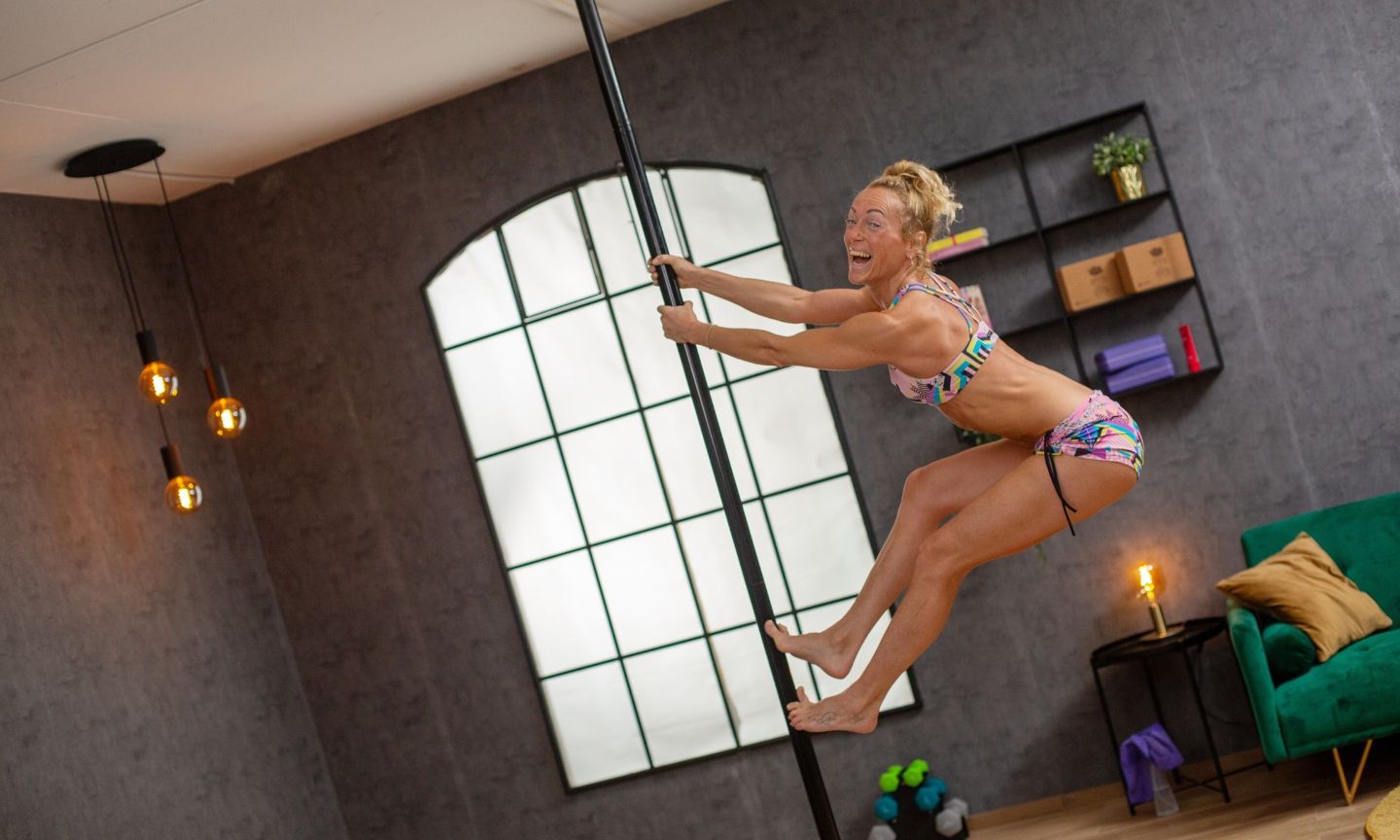
The best pole spins for beginners keep you upright and close to the floor: the Fireman Spin, Chair Spin, Carousel Spin and Baby Spin are classic first spins, followed by open shapes like the Around The World, Spider Spin, Tinkerbell Spin and Froggy Spin. All of them use the same basic spin grip, and all of them work on a static and on a spinning pole. Here is how they compare, how the grip works and what to watch out for.
Static or spinning pole: which is better for spins?
Most home poles can switch between two modes, and spins feel quite different in each.
| Static pole | Spinning pole | |
|---|---|---|
| What the pole does | Stays still | Turns with you |
| Where the momentum comes from | Your walk and step into the spin | Mostly from the pole once it turns |
| How the spin feels | Short and controlled | Longer, softer, more floating |
| Good for | Learning the shape and the grip | Flow, combos, enjoying the ride |
| Watch out for | Creating enough momentum | Dizziness and spinning too fast |
On a static pole you create the whole movement yourself. That makes it a great place to learn a new spin, because you feel exactly how much momentum you need and where your grip has to work. On a spinning pole the pole turns with you, so a spin can last much longer with very little effort. The tricky part is control: you need to stay close to the pole and keep your body compact, or the pole speeds up more than you want.
Many dancers learn a spin in static mode first and then try it in spinning mode once the shape feels familiar. The move pages in our library say the same for each spin: both modes work, they just feel different.
How does the basic spin grip work?
Almost every beginner spin starts from the same grip, often called the split grip or spin grip.
- Stand next to the pole, slightly to the side, with the pole close to your hip.
- Top hand high. Your hand closest to the pole reaches up and wraps around it at about head height or a little above.
- Bottom hand lower. Your other hand holds the pole lower down, around hip height, with the arm reaching across your body.
- Pull and push. In the spin your top hand pulls you towards the pole and carries much of your weight, while your bottom arm pushes away to create a stable frame. This push and pull is what keeps you from sliding down too fast.
- Keep the arms long. A long top arm hangs from the shoulder instead of the bicep, which saves strength.
You do not need much strength for your first spins. If you can hold the pole while standing and walk around it, you are ready to start. Your grip builds with every spin, and if you want to train it off the pole too, our pole strength exercises are a good addition.
8 pole spins for beginners
The spins below are all listed as beginner moves in our Moves Library. The order is a common path, but your course or coach may suggest a different one.
1. Fireman Spin
The Fireman Spin is the spin most pole journeys start with. You step around the pole, lift your legs and travel down with your knees bent and close together, your body upright and your legs near the pole. It teaches grip, momentum and a soft landing, the basics of every spin that comes after.
2. Chair Spin
In the Chair Spin your knees tuck into a seated shape in front of you, as if you were sitting on an invisible chair. Because your legs float free instead of staying near the pole, your hands and core do a bit more work than in the Fireman Spin. Many dancers learn the two side by side.
3. Carousel Spin
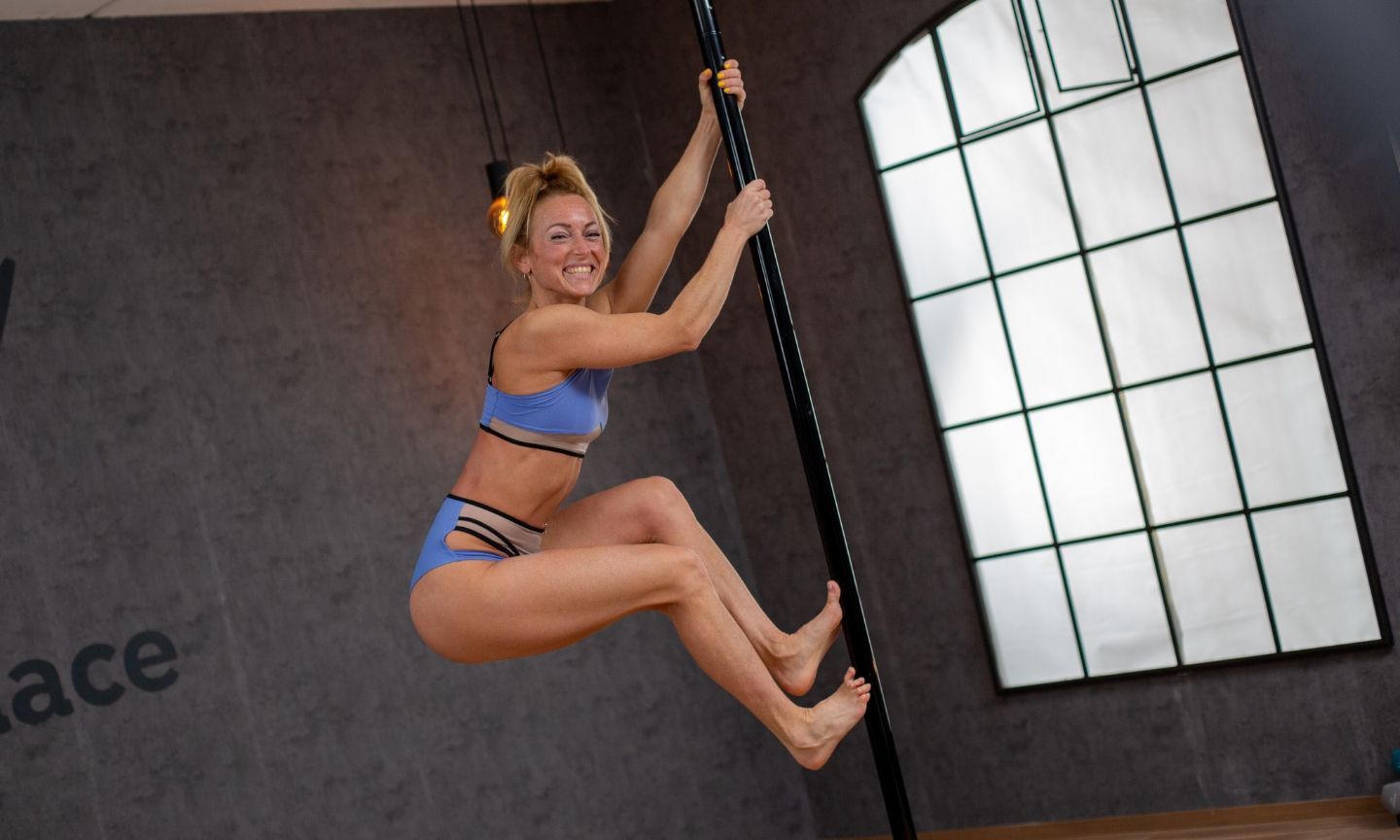
The Carousel Spin bends your knees the other way: your feet float back towards your bum while your knees point down. Your body stays upright and the spin looks round and playful, a nice second spin after the Fireman.
4. Baby Spin
The Baby Spin is a compact, tucked spin. Your knees stay together and close to your body while you lean a little sideways beside the pole. It shows you how a smaller shape changes the speed and feel of a spin.
5. Around The World
The Around The World, also called the Juliet Spin, does the opposite of tucking in. You lean out in a long, open line and draw a big circle around the pole with your body and free arm. It is a lovely spin for filling the space around your pole.
6. Spider Spin
The Spider Spin stays low and wide. You sink into a deep position with your knees open to the sides and turn around the pole in that shape. It feels grounded and confident and adds attitude to a routine.
7. Tinkerbell Spin
In the Tinkerbell Spin your legs open into a light stride, one knee softly bent and the other leg reaching long behind you. It is an open, airy spin and works best once a first spin like the Fireman feels familiar.
8. Froggy Spin
The Froggy Spin combines a bent, turned-out leg at the pole with a long lean away from it and a free arm reaching into the room. Leaning away is new here, so it is a good choice once you have a spin or two under your belt.
What comes after?
When these feel steady, spins like the Wine Glass Spin and the Phoenix Spin are classic next goals. Both are intermediate spins with open legs in the air, so your grip and upper body do more of the work.
Common mistakes with beginner spins
Getting dizzy
Spinning makes many beginners dizzy at first, especially on a spinning pole. Start with only a few spins in a row, take breaks, and alternate directions. Keep your gaze on one point during the spin instead of letting your eyes follow the room. If you feel unwell, stop and sit down.
Too much or too little momentum
On a static pole, a spin without enough momentum stops halfway and you slide down. Take a real step around the pole and start the spin while you are moving. On a spinning pole the opposite happens: a big swing makes the pole turn fast. Start with a gentle push and keep your body close to the pole.
Hand placement
Hands too close together give you no frame, and a bent top arm tires you out quickly. Keep a clear distance between your hands, the top arm long and the bottom arm pushing. Dry hands matter as much as position: clean the pole and skip lotion on training days.
Hard landings
The spin is not over until your feet are on the floor. Lower down with control, land softly through your feet and finish the shape. A crash mat under the pole gives you extra confidence.
Training only one side
Most dancers have a favourite side. Practise every spin on both sides, even if the weaker side looks less pretty for a while.
FAQ
What is the easiest pole spin for beginners?
The Fireman Spin is the classic first spin. You stay upright, your legs stay close to the pole and you never leave the floor for long.
Should beginners spin on a static or a spinning pole?
Most beginners learn a new spin in static mode first, because it shows how much momentum they create themselves. Spinning mode is a great next step once the shape feels familiar.
How do I stop getting dizzy when I spin?
Keep your sessions short at first, do only a few spins in a row, change directions and fix your gaze on one point. Dizziness usually gets better as you get used to spinning.
Do I need strength for my first pole spin?
Not much. If you can hold the pole while standing and walk around it, you can start. Grip and core strength grow with practice.
How long does it take to learn a spin?
That is different for everyone and depends on how often you train. Some spins click in one session, others take a few, and both are completely normal.
What next?
Want to learn your first spins in a clear order? Spin School is our Level 1 spin series, and if you are completely new to pole, the 12-Week Starter Course is the place to start. Your first 7 days are free.
What next?
Start with Class 1 of our 12-Week Starter Course. Every move is taught with our Floor-Stand-Air Method™: on the floor first, then standing, then in the air.