
10% off at Lupit Pole
We train on Lupit Pole. With the code POLEPLACE10 you get 10% off in the Lupit shop.
Yes, you can learn pole dancing online, and many dancers start exactly that way. What makes it work is not the screen but the structure behind it: classes that build on each other in clear levels, safety cues in every lesson, and a way to get feedback when you need it. Add a safe pole at home, a little space and a mat, and you have everything you need for your first spin.
Does learning pole dancing online really work?
It does, as long as the program does the job a good teacher does in a studio. In a studio class, a coach decides what you learn next, reminds you to warm up, explains what to feel in each move and stops you before you try something too early. An online class has to do the same things, just in a different way: through the order of the videos, through clear explanations and through cues you can hear while you move.
Online training also has some real strengths of its own:
- You train when it fits your day. Early morning, late evening, ten minutes or a full hour.
- You can repeat a move as often as you like. Pause, rewind, watch the tricky part again.
- You train in private. No one watches you while you figure out your first spin. For many beginners, that is what makes starting possible at all.
- You learn at your own pace. If a move needs three more sessions, it gets three more sessions.
What online training cannot do on its own is look at you. That is why the best setups combine on-demand videos with live classes and a few habits that replace a coach’s eye, like filming yourself. More on that below.
What should good online pole dancing classes offer?
Not every video library is a course. If you compare online pole classes or apps, these are the points that make the difference between scrolling through random tutorials and making steady progress.
| What to look for | Why it matters |
|---|---|
| Structured levels | You always know where you are and what comes next, instead of guessing. |
| Clear progression | Each move prepares the next one, so strength and technique grow together. |
| Safety cues | You learn where to place your hands, when to stop and what to build first. |
| Warm-ups and conditioning | Pole asks a lot of your grip, shoulders and core. Good programs train them on purpose. |
| Live classes | Training in real time with a coach adds energy, rhythm and a sense of being part of something. |
| Your language | Small cues like “push with your bottom hand” land faster in the language you think in. |
| App and web | You can train on your phone next to the pole or on a bigger screen in the browser. |
Structured levels and progression
The most important point is the order. A beginner should start on the floor and close to the pole, with walks, simple spins and floorwork, and only later move up into climbs and holds in the air. A good program makes this path visible, for example as a beginner course with a fixed sequence of classes. If an app drops you into a library of hundreds of moves without telling you where to start, you end up picking whatever looks fun, and that is often not what your body is ready for.
Safety cues in every class
Pole is safe when you build it in the right order. In every tutorial you should hear where your hands go, which part of your body holds you, how to come down and when a move is not for you yet. Warm-ups should be part of the program, not an afterthought, and so should cool-downs and stretching.
Live classes for feedback and motivation
On-demand videos are great for learning a move step by step. Live classes add something else: a fixed date in your calendar, music, a coach who talks you through the session in real time, and the feeling of training with others even though you are alone in your living room. If a program also keeps replays, you never lose a class just because the time did not fit.
Both languages, one account
If you think in German but train in English (or the other way round), you know how much a cue can get lost. Programs that offer classes in more than one language make it easier to understand fine details like hand placement or which hip to turn. And one account that works in the app and in the browser means you can switch screens without starting over.
How do you set up for online pole classes at home?
You need three things: a safe pole, enough space around it, and a mat. Everything else is a bonus.
The pole
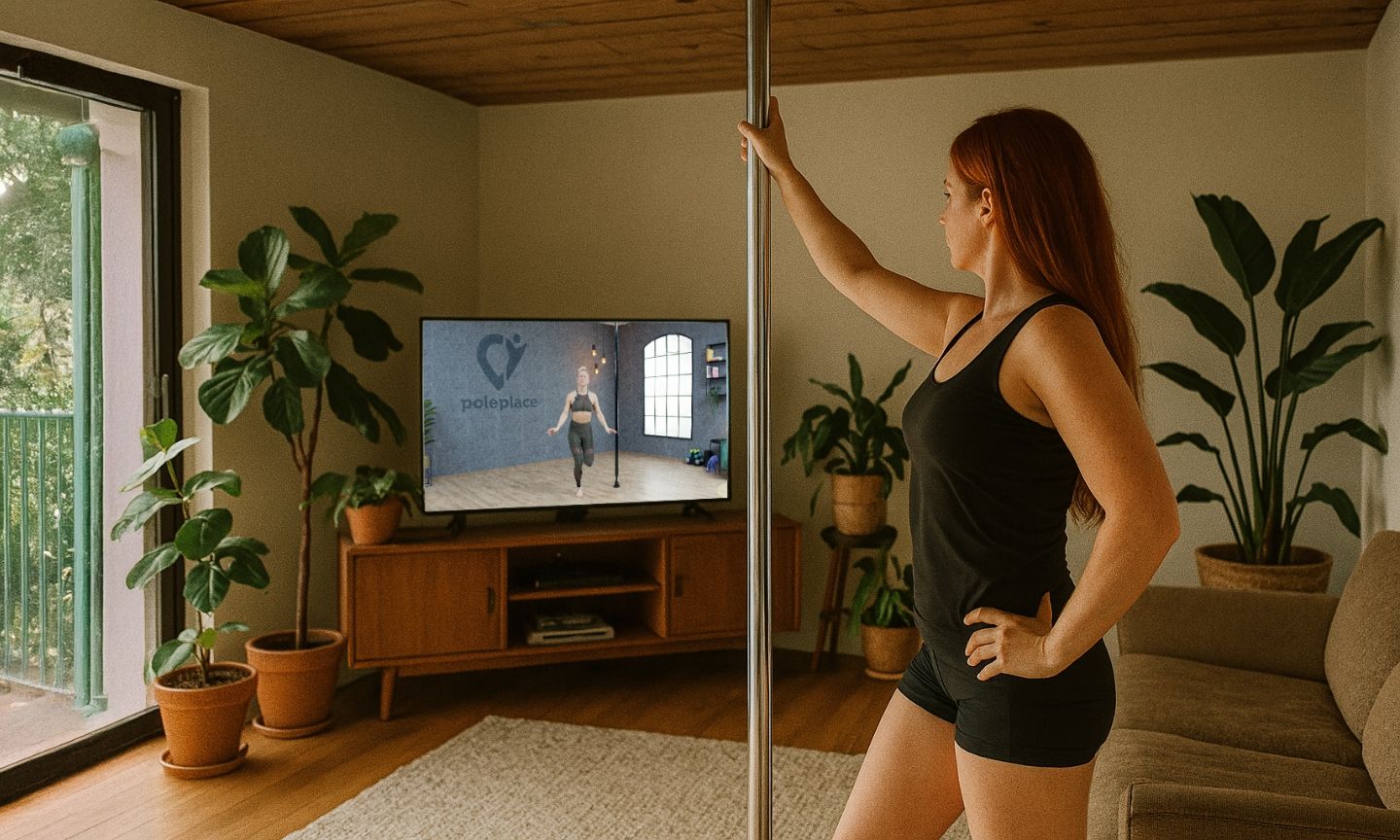
A good home pole is the foundation of your training. Most beginners choose a removable pressure-mounted pole that sits between floor and ceiling and can switch between static and spinning mode. Static mode stays still, so you create the movement yourself. Spinning mode turns with you and feels softer and longer. Our pole buying guide for beginners explains what to look for, from diameter to ceiling height. Our partner Lupit Pole makes popular home poles, and with the code POLEPLACE10 you get 10 % off.
Always follow the installation instructions of your pole exactly, and check that it sits tight before every session.
The space
Plan for enough room to walk around the pole with your arms stretched out without touching furniture, walls or lamps. Keep the floor around the pole clear and dry. If you rent, check your ceiling with the pole manufacturer’s guidelines before you install anything.
The mat and the rest
A crash mat under the pole softens slips and gives you confidence once you start leaving the floor. Train with bare legs and arms where the moves need skin contact, because skin is what grips the pole. Skip body lotion on training days. A towel and a little cleaning spray for the pole keep the surface dry. Place your phone, tablet or laptop where you can see it while facing the pole.
How to get the most out of learning pole online
These habits make online training feel a lot less like “watching videos” and a lot more like a real class.
- Follow a course, not your mood. Start with the first class of a beginner program and go in order.
- Warm up every time. Even five minutes for wrists, shoulders and hips.
- Film yourself. A short clip from the side shows you things you cannot feel, like bent arms or a hip that drops.
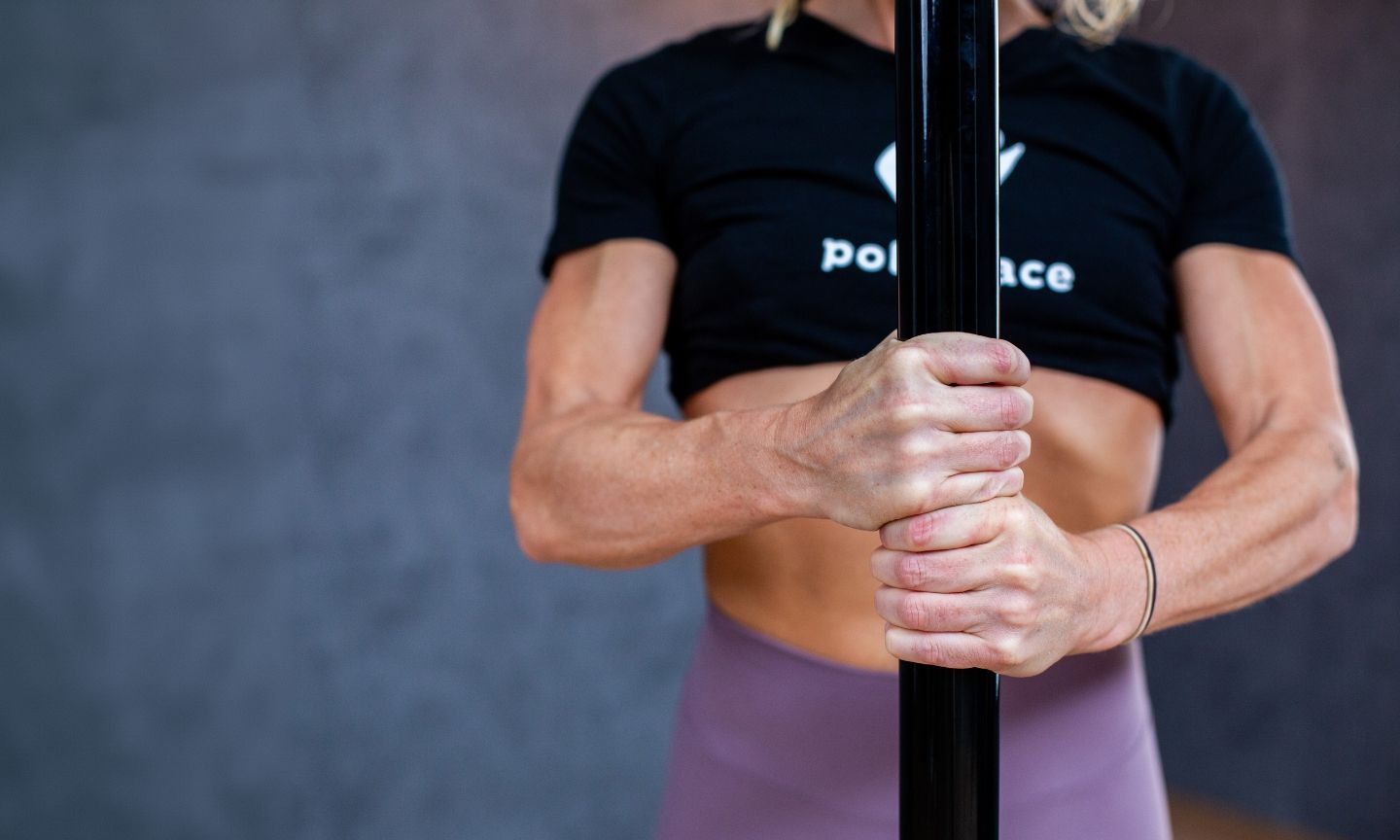
- Watch first, then try. Watch the whole explanation once before you start, then follow along.
- Stop when it hurts. Muscle effort is normal, sharp pain is not. If something keeps hurting, talk to your doctor or physio.
- Join live classes. A fixed date keeps you consistent, and you train with a coach in real time.
- Train regularly, not endlessly. Short sessions a few times a week help more than one exhausting marathon.
How does POLEPLACE work?
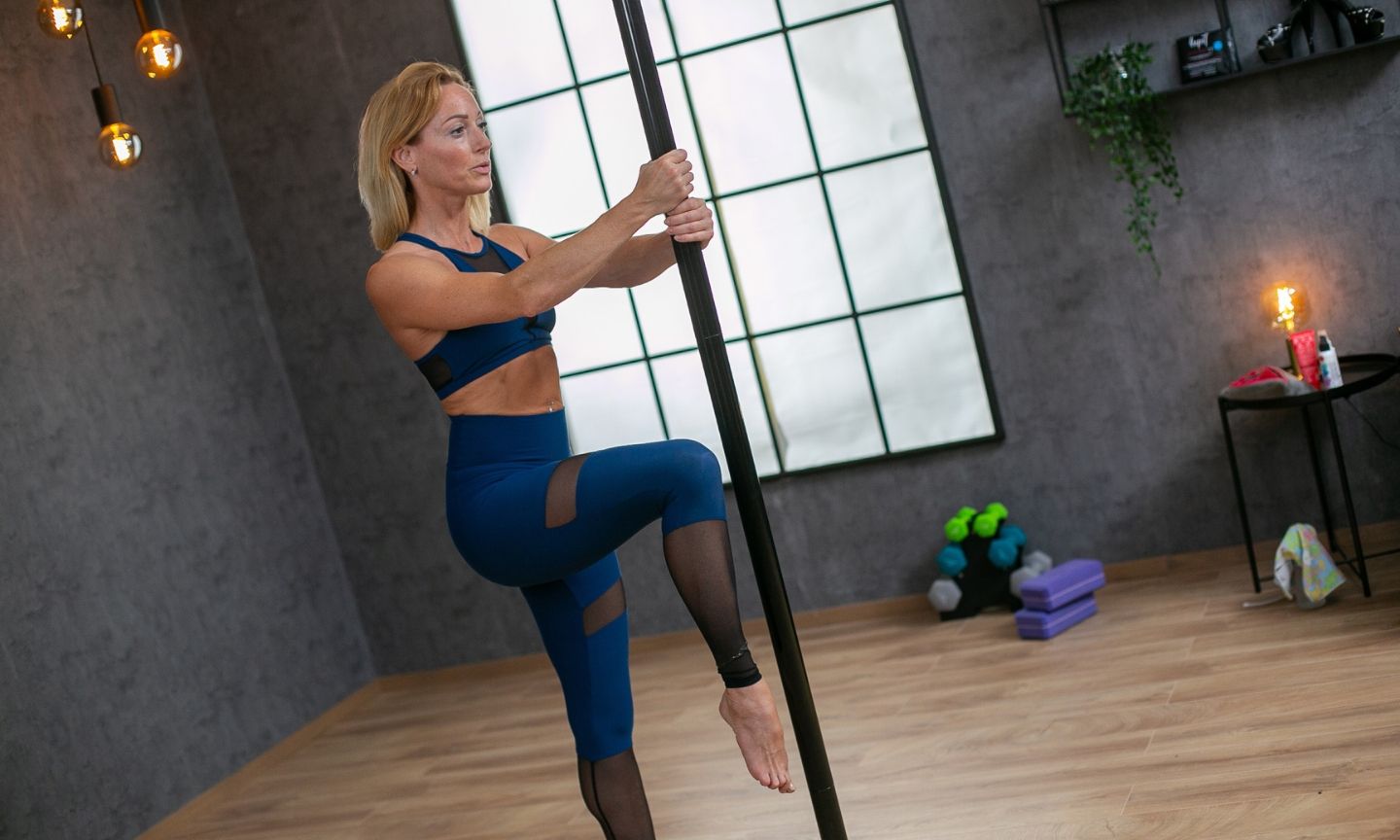
POLEPLACE is an online pole dance studio for women, built for training at home without pressure. Here is what you get as a member:
- The 12-Week Starter Course for complete beginners, with a clear order of classes from your first walk around the pole onwards.
- Programs that go deeper into one topic, from Spin School to climbs, floorwork, inverts, strength and flexibility. You find them all on our programs page.
- Live classes, at least three a month with guest coaches from the pole world, plus the replays if a date does not fit your week.
- A moves library with tutorials for single moves, so you can look up a spin or a hold whenever you need it. Browse it in the Moves Library.
- Classes in English and German, taught step by step with the Floor-Stand-Air Method™: first on the floor, then standing, then in the air.
- The app for iOS and Android, plus any browser. In the app you can download videos to train offline, change the playback speed and build playlists. See the app page for details.
Membership starts with 7 days free. After that it is $29 a month, $79 a quarter or $299 a year, and every plan includes everything.
FAQ
Can a complete beginner learn pole dancing online?
Yes. A structured beginner course that starts on the floor and close to the pole is a good way in. You do not need any strength or flexibility to begin, it builds as you train.
What equipment do I need for online pole dance classes?
A safe, correctly installed pole, enough free space around it and ideally a crash mat. A phone, tablet or laptop to watch the class is enough for the screen.
Static or spinning pole for online classes?
Most beginners start in static mode, because it gives you more control and shows how much movement you create yourself. A pole that can switch between both modes lets you try spinning mode once your first spins feel steady.
How often should I train?
A few shorter sessions a week work well for most beginners. Your hands and skin need time to get used to the pole, so rest days are part of the plan.
How do I get feedback when I learn pole online?
Film yourself and compare your clip with the tutorial, and join live classes where you train with a coach in real time. Both help you notice details you cannot feel yet.
What next?
If you want a clear path instead of random videos, start with the 12-Week Starter Course. Your first 7 days are free, and class 1 takes you through your first steps at the pole, at your own pace.
What next?
Start with Class 1 of our 12-Week Starter Course. Every move is taught with our Floor-Stand-Air Method™: on the floor first, then standing, then in the air.